

• Leisure Rentals to Grow Fastest — Luxury Cars for Vacations, Weddings & Special Occasions

    Luxury Car Rental Market: Driving Luxury Mobility with Premium Experiences

    The Luxury Car Rental Market is witnessing steady global growth as consumers increasingly prefer premium mobility solutions for business travel, leisure experiences, and special events. According to Stellar Market Research, the global luxury car rental market was valued at approximately USD 57.76 billion in 2024 and is estimated to grow at a compound annual growth rate (CAGR) of about 5.5 % from 2025 to 2032, reaching USD 88.64 billion by 2032. (turn0search0; turn0search2)

    Luxury car rentals — which provide high‑end vehicles such as premium sedans, SUVs, and exotic marques for short‑ or long‑term use — cater to affluent consumers, corporate clients, and travelers seeking superior comfort, performance, and prestige without the cost and commitment of ownership.

    Request Free Sample Report : https://www.stellarmr.com/report/req_sample/luxury-car-rental-market/2554
    Market Estimation & Definition
    A luxury car rental service offers access to high‑performance, high‑comfort vehicles from renowned brands such as Mercedes‑Benz, BMW, Audi, Porsche, and Rolls‑Royce for flexible periods, often ranging from hours to weeks. These rentals are used for executive travel, holidays, airport transport, weddings, VIP events, and experiential leisure journeys. The infrastructure supporting luxury rentals includes both online booking platforms and traditional offline rental desks at airports, city hubs, and upscale hotels. (turn0search0)

    This market segment has evolved beyond traditional rental agencies as digitalization allows customers to review, select, and reserve luxury vehicles online with real‑time availability, pricing comparisons, and personalized service options. (turn0search0)

    Market Growth Drivers & Opportunity
    Several core factors are driving the luxury car rental market:

    1. Rising Disposable Incomes & Premium Travel Demand
    Growing disposable incomes, increased international travel, and the expanding global affluent population are elevating demand for high‑end experiences, including luxury vehicle rentals during trips and events. Consumers — especially millennials and Gen Z — increasingly choose experience‑based mobility over ownership. (turn0search2)

    2. Business Mobility Requirements
    Luxury rentals serve a crucial role in corporate mobility, conference travel, executive engagements, and incentive travel programs. Businesses are opting for premium rentals for comfort, status, and productivity on the road without adding capital assets to their balance sheets. (turn0search0)

    3. Digitization & Online Booking Adoption
    Online reservations dominate the booking landscape, capturing a significant share as customers prefer the convenience of comparing luxury vehicle inventory, pricing, and features before confirming a rental. Young, tech‑savvy consumers and frequent travelers drive this shift globally. (turn0search0)

    4. Experiential and Tourism‑Led Travel Trends
    Luxury car rentals are bundled with high‑end tourism packages, luxury hotel experiences, and travel events, making them part of broader luxury lifestyles rather than just transport solutions — a trend that continues to expand market opportunities. (turn0search2)

    Request Free Sample Report : https://www.stellarmr.com/report/req_sample/luxury-car-rental-market/2554
    What Lies Ahead: Emerging Trends Shaping the Future
    Shift Toward Electric & Hybrid Luxury Fleets
    Sustainability concerns and stricter emission norms are prompting rental companies to integrate electric and hybrid luxury vehicles into their fleets. This supports eco‑luxury travel and aligns with corporate ESG priorities. (turn0search2)


    About us

    Phase 3,Navale IT Zone, S.No. 51/2A/2,

    Office No. 202, 2nd floor,

    Near, Navale Brg,Narhe,

    Pune, Maharashtra 411041

    sales@stellarmr.com

    Leisure Rentals to Grow Fastest — Luxury Cars for Vacations, Weddings & Special Occasions Luxury Car Rental Market: Driving Luxury Mobility with Premium Experiences The Luxury Car Rental Market is witnessing steady global growth as consumers increasingly prefer premium mobility solutions for business travel, leisure experiences, and special events. According to Stellar Market Research, the global luxury car rental market was valued at approximately USD 57.76 billion in 2024 and is estimated to grow at a compound annual growth rate (CAGR) of about 5.5 % from 2025 to 2032, reaching USD 88.64 billion by 2032. (turn0search0; turn0search2) Luxury car rentals — which provide high‑end vehicles such as premium sedans, SUVs, and exotic marques for short‑ or long‑term use — cater to affluent consumers, corporate clients, and travelers seeking superior comfort, performance, and prestige without the cost and commitment of ownership. Request Free Sample Report : https://www.stellarmr.com/report/req_sample/luxury-car-rental-market/2554 Market Estimation & Definition A luxury car rental service offers access to high‑performance, high‑comfort vehicles from renowned brands such as Mercedes‑Benz, BMW, Audi, Porsche, and Rolls‑Royce for flexible periods, often ranging from hours to weeks. These rentals are used for executive travel, holidays, airport transport, weddings, VIP events, and experiential leisure journeys. The infrastructure supporting luxury rentals includes both online booking platforms and traditional offline rental desks at airports, city hubs, and upscale hotels. (turn0search0) This market segment has evolved beyond traditional rental agencies as digitalization allows customers to review, select, and reserve luxury vehicles online with real‑time availability, pricing comparisons, and personalized service options. (turn0search0) Market Growth Drivers & Opportunity Several core factors are driving the luxury car rental market: 1. Rising Disposable Incomes & Premium Travel Demand Growing disposable incomes, increased international travel, and the expanding global affluent population are elevating demand for high‑end experiences, including luxury vehicle rentals during trips and events. Consumers — especially millennials and Gen Z — increasingly choose experience‑based mobility over ownership. (turn0search2) 2. Business Mobility Requirements Luxury rentals serve a crucial role in corporate mobility, conference travel, executive engagements, and incentive travel programs. Businesses are opting for premium rentals for comfort, status, and productivity on the road without adding capital assets to their balance sheets. (turn0search0) 3. Digitization & Online Booking Adoption Online reservations dominate the booking landscape, capturing a significant share as customers prefer the convenience of comparing luxury vehicle inventory, pricing, and features before confirming a rental. Young, tech‑savvy consumers and frequent travelers drive this shift globally. (turn0search0) 4. Experiential and Tourism‑Led Travel Trends Luxury car rentals are bundled with high‑end tourism packages, luxury hotel experiences, and travel events, making them part of broader luxury lifestyles rather than just transport solutions — a trend that continues to expand market opportunities. (turn0search2) Request Free Sample Report : https://www.stellarmr.com/report/req_sample/luxury-car-rental-market/2554 What Lies Ahead: Emerging Trends Shaping the Future Shift Toward Electric & Hybrid Luxury Fleets Sustainability concerns and stricter emission norms are prompting rental companies to integrate electric and hybrid luxury vehicles into their fleets. This supports eco‑luxury travel and aligns with corporate ESG priorities. (turn0search2) About us Phase 3,Navale IT Zone, S.No. 51/2A/2, Office No. 202, 2nd floor, Near, Navale Brg,Narhe, Pune, Maharashtra 411041 sales@stellarmr.com
    0 Yorumlar 0 hisse senetleri 4 Views 0 önizleme
  • United States Air Purifier Market Growth Outlook (2025–2032): Size, Trends & Forecast

    United States Air Purifier Market: Clean Air for Health-Conscious Consumers

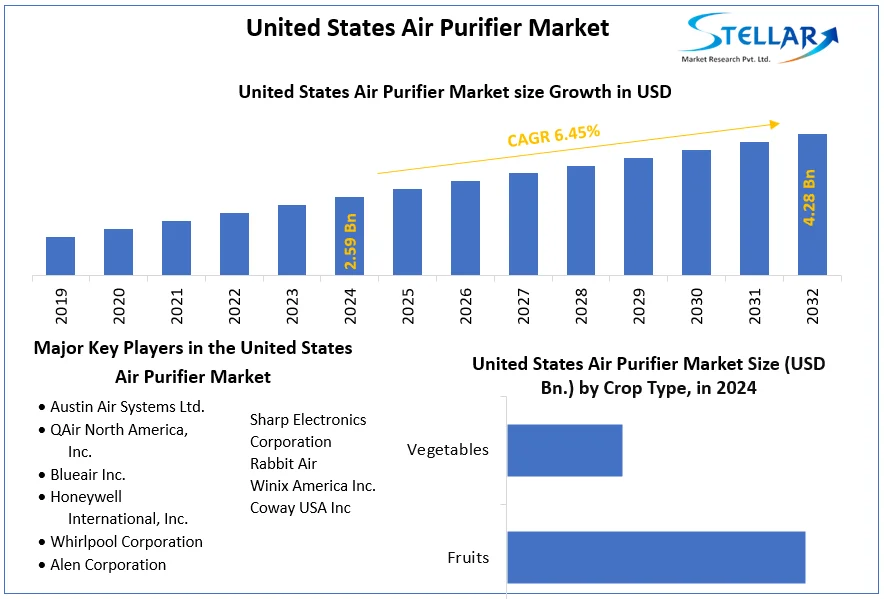
    The United States Air Purifier Market is poised for steady growth as awareness of indoor air quality, health concerns, and environmental pollution intensifies across residential and commercial spaces. According to the Stellar Market Research analysis, the U.S. air purifier market was valued at approximately USD 2.59 billion in 2024 and is projected to reach USD 4.28 billion by 2032, growing at a compound annual growth rate (CAGR) of around 6.45 % through 2032. This underscores rising consumer spending on air quality solutions as health awareness and environmental concerns become more central to everyday life.

    Request Free Sample Report : https://www.stellarmr.com/report/req_sample/United-States-Air-Purifier-Market/129

    Market Estimation & Definition

    Air purifiers are devices designed to remove contaminants from the air, including dust, pollen, smoke, odors, and microscopic particles, thereby improving indoor air quality and reducing health risks associated with air pollution. These systems are used in homes, offices, healthcare facilities, educational institutions, hospitality settings, and various commercial environments to ensure clean and breathable air for occupants.

    Indoor air can contain pollutants at levels significantly higher than outdoor air due to limited circulation and the presence of chemical emissions, allergens, tobacco smoke, and other contaminants. As a result, air purifiers have become valuable appliances for maintaining cleaner air, particularly for individuals with respiratory conditions or heightened sensitivity to environmental pollutants.

    Market Growth Drivers & Opportunity

    Several key factors are driving the growth of the U.S. air purifier market:

    Rising Pollution and Health Awareness: Increasing levels of indoor and outdoor air pollution have heightened health concerns, particularly related to respiratory illnesses such as asthma, bronchitis, and allergic reactions. Air purifiers help mitigate exposure to airborne particles and allergens, supporting better health outcomes.

    Impact of COVID-19 and Infectious Disease Awareness: The COVID-19 pandemic elevated awareness of airborne pathogens and the importance of clean air, prompting consumers and businesses to adopt advanced air purification technologies to reduce the risk of airborne disease transmission.

    Urbanization and Lifestyle Changes: Rapid urban growth, higher population density, increased vehicle emissions, and lifestyle changes that keep people indoors longer have accelerated demand for effective air purification systems.

    Commercial Demand Expansion: Businesses, educational institutions, healthcare facilities, and hospitality venues are increasingly installing air purifiers to protect occupants and enhance indoor environmental quality, boosting commercial market adoption.

    Despite strong growth, high operational and maintenance costs—largely related to energy consumption and filter replacement—remain a restraint for some consumers.

    Request Free Sample Report : https://www.stellarmr.com/report/req_sample/United-States-Air-Purifier-Market/129

    What Lies Ahead: Emerging Trends Shaping the Future

    The U.S. air purifier market is evolving around several key trends:

    About us

    Phase 3,Navale IT Zone, S.No. 51/2A/2,

    Office No. 202, 2nd floor,

    Near, Navale Brg,Narhe,

    Pune, Maharashtra 411041

    sales@stellarmr.com
    United States Air Purifier Market Growth Outlook (2025–2032): Size, Trends & Forecast United States Air Purifier Market: Clean Air for Health-Conscious Consumers The United States Air Purifier Market is poised for steady growth as awareness of indoor air quality, health concerns, and environmental pollution intensifies across residential and commercial spaces. According to the Stellar Market Research analysis, the U.S. air purifier market was valued at approximately USD 2.59 billion in 2024 and is projected to reach USD 4.28 billion by 2032, growing at a compound annual growth rate (CAGR) of around 6.45 % through 2032. This underscores rising consumer spending on air quality solutions as health awareness and environmental concerns become more central to everyday life. Request Free Sample Report : https://www.stellarmr.com/report/req_sample/United-States-Air-Purifier-Market/129 Market Estimation & Definition Air purifiers are devices designed to remove contaminants from the air, including dust, pollen, smoke, odors, and microscopic particles, thereby improving indoor air quality and reducing health risks associated with air pollution. These systems are used in homes, offices, healthcare facilities, educational institutions, hospitality settings, and various commercial environments to ensure clean and breathable air for occupants. Indoor air can contain pollutants at levels significantly higher than outdoor air due to limited circulation and the presence of chemical emissions, allergens, tobacco smoke, and other contaminants. As a result, air purifiers have become valuable appliances for maintaining cleaner air, particularly for individuals with respiratory conditions or heightened sensitivity to environmental pollutants. Market Growth Drivers & Opportunity Several key factors are driving the growth of the U.S. air purifier market: Rising Pollution and Health Awareness: Increasing levels of indoor and outdoor air pollution have heightened health concerns, particularly related to respiratory illnesses such as asthma, bronchitis, and allergic reactions. Air purifiers help mitigate exposure to airborne particles and allergens, supporting better health outcomes. Impact of COVID-19 and Infectious Disease Awareness: The COVID-19 pandemic elevated awareness of airborne pathogens and the importance of clean air, prompting consumers and businesses to adopt advanced air purification technologies to reduce the risk of airborne disease transmission. Urbanization and Lifestyle Changes: Rapid urban growth, higher population density, increased vehicle emissions, and lifestyle changes that keep people indoors longer have accelerated demand for effective air purification systems. Commercial Demand Expansion: Businesses, educational institutions, healthcare facilities, and hospitality venues are increasingly installing air purifiers to protect occupants and enhance indoor environmental quality, boosting commercial market adoption. Despite strong growth, high operational and maintenance costs—largely related to energy consumption and filter replacement—remain a restraint for some consumers. Request Free Sample Report : https://www.stellarmr.com/report/req_sample/United-States-Air-Purifier-Market/129 What Lies Ahead: Emerging Trends Shaping the Future The U.S. air purifier market is evolving around several key trends: About us Phase 3,Navale IT Zone, S.No. 51/2A/2, Office No. 202, 2nd floor, Near, Navale Brg,Narhe, Pune, Maharashtra 411041 sales@stellarmr.com
    0 Yorumlar 0 hisse senetleri 2 Views 0 önizleme
  • https://m2squareconsultancy.com/reports/formulation-development-outsourcing-market
    https://m2squareconsultancy.com/reports/formulation-development-outsourcing-market
    M2SQUARECONSULTANCY.COM
    Formulation Development Outsourcing Market Forecast to 2033
    The Formulation Development Outsourcing Market is set to grow from USD 30.4B in 2025 to USD 60.5B by 2033, with a strong CAGR of 9.1% during the forec...
    0 Yorumlar 0 hisse senetleri 4 Views 0 önizleme
  • Low‑Calorie & Functional Drinks: The Rise of Flavoured Water Over Sugary Beverages

    Flavoured Water Market: Hydration Meets Health‑Driven Beverage Innovation

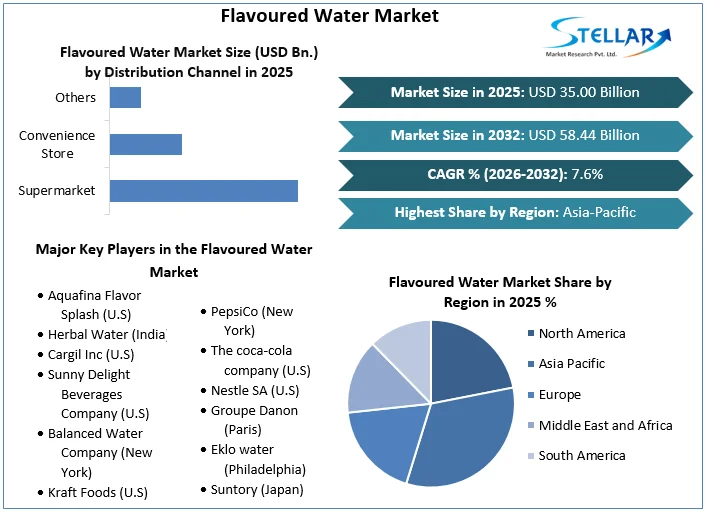
    The Flavoured Water Market has rapidly emerged as one of the most dynamic segments of the global beverage industry, driven by changing consumer preferences toward healthier hydration alternatives. Valued at approximately USD 35 billion in 2025, the global market is projected to grow at a compound annual growth rate (CAGR) of around 7.6 % from 2026 to 2032, reaching an estimated USD 58.44 billion by 2032. This robust growth underscores the rising demand for low‑calorie, flavour‑infused waters that provide taste, functional benefits, and perceived nutritional value compared to sugary soft drinks.

    Request Free Sample Report : https://www.stellarmr.com/report/req_sample/Flavoured-Water-Market/299

    Market Estimation & Definition

    Flavoured water refers to water enhanced with natural or artificial flavours, sweeteners (sugar or zero‑calorie alternatives), vitamins, minerals, and sometimes fruit essences or herb infusions to improve taste while offering hydration with minimal calories. These beverages are positioned as healthier options that support weight management, hydration, and wellness goals, particularly among urban and health‑conscious consumers seeking alternatives to traditional carbonated drinks. Compared with sugary soft drinks, flavoured water tends to contain fewer calories and can be formulated to offer added benefits such as vitamin enrichment, appealing to a broad consumer base focused on nutrition and wellbeing.

    Market Growth Drivers & Opportunity

    Several key factors are driving the flavoured water market’s strong growth:

    Health and Wellness Trends: Increasing health consciousness has shifted consumer demand away from high‑sugar beverages toward products perceived as healthier. Flavoured water, with low or no added sugar and enriched nutritional profiles, is positioned as a functional hydration alternative.

    Rising Obesity and Sugar Concerns: Growing concerns over obesity, diabetes, and sugar‑related health issues are prompting consumers to opt for beverages with reduced or zero calories. Flavoured water meets these needs without compromising on taste.

    Innovation in Product Offerings: Beverage companies are developing diverse flavour portfolios — including fruit‑infused, herb‑based, and electrolyte‑enhanced varieties — to appeal to evolving consumer preferences and broaden market appeal.

    Distribution Expansion: Wider availability through supermarkets, convenience stores, and online platforms supports market penetration and convenience for consumers. Supermarkets, in particular, dominate distribution due to extensive product ranges and accessibility.

    Urbanization and Higher Disposable Income: Rising urbanization and increasing incomes in emerging economies are enhancing purchasing power for premium and health‑oriented beverages.

    Together, these trends create compelling opportunities for beverage manufacturers to expand into new geographies, innovate with functional ingredients, and tailor products to specific consumer segments.

    What Lies Ahead: Emerging Trends Shaping the Future

    Several trends are expected to influence the flavoured water market through 2032:

    Sparkling Flavoured Water Leadership: Sparkling flavoured water holds the largest market share — over 59 % in 2025 — as a refreshing, low‑calorie alternative to traditional carbonated soft drinks, appealing particularly to younger and health‑oriented consumers.

    Functional and Enhanced Beverages: Formulations with added vitamins, minerals, antioxidants, and electrolytes are gaining traction as value‑added options that support hydration, wellness, and even performance.

    Clean‑Label and Natural Ingredients: Growing consumer demand for natural and fewer artificial additives is prompting beverage brands to use clean‑label ingredients, natural flavours, and plant‑based extracts.

    Sustainability and Packaging Innovation: With environmental consciousness rising, consumers are increasingly sensitive to packaging sustainability, driving innovation in recyclable and eco‑friendly bottle formats.

    Request Free Sample Report : https://www.stellarmr.com/report/req_sample/Flavoured-Water-Market/299

    Segmentation Analysis from the Report

    According to the StellarMR report, the flavoured water market is segmented by type and distribution channel:

    By Type:

    About us

    Phase 3,Navale IT Zone, S.No. 51/2A/2,

    Office No. 202, 2nd floor,

    Near, Navale Brg,Narhe,

    Pune, Maharashtra 411041

    sales@stellarmr.com
    Low‑Calorie & Functional Drinks: The Rise of Flavoured Water Over Sugary Beverages Flavoured Water Market: Hydration Meets Health‑Driven Beverage Innovation The Flavoured Water Market has rapidly emerged as one of the most dynamic segments of the global beverage industry, driven by changing consumer preferences toward healthier hydration alternatives. Valued at approximately USD 35 billion in 2025, the global market is projected to grow at a compound annual growth rate (CAGR) of around 7.6 % from 2026 to 2032, reaching an estimated USD 58.44 billion by 2032. This robust growth underscores the rising demand for low‑calorie, flavour‑infused waters that provide taste, functional benefits, and perceived nutritional value compared to sugary soft drinks. Request Free Sample Report : https://www.stellarmr.com/report/req_sample/Flavoured-Water-Market/299 Market Estimation & Definition Flavoured water refers to water enhanced with natural or artificial flavours, sweeteners (sugar or zero‑calorie alternatives), vitamins, minerals, and sometimes fruit essences or herb infusions to improve taste while offering hydration with minimal calories. These beverages are positioned as healthier options that support weight management, hydration, and wellness goals, particularly among urban and health‑conscious consumers seeking alternatives to traditional carbonated drinks. Compared with sugary soft drinks, flavoured water tends to contain fewer calories and can be formulated to offer added benefits such as vitamin enrichment, appealing to a broad consumer base focused on nutrition and wellbeing. Market Growth Drivers & Opportunity Several key factors are driving the flavoured water market’s strong growth: Health and Wellness Trends: Increasing health consciousness has shifted consumer demand away from high‑sugar beverages toward products perceived as healthier. Flavoured water, with low or no added sugar and enriched nutritional profiles, is positioned as a functional hydration alternative. Rising Obesity and Sugar Concerns: Growing concerns over obesity, diabetes, and sugar‑related health issues are prompting consumers to opt for beverages with reduced or zero calories. Flavoured water meets these needs without compromising on taste. Innovation in Product Offerings: Beverage companies are developing diverse flavour portfolios — including fruit‑infused, herb‑based, and electrolyte‑enhanced varieties — to appeal to evolving consumer preferences and broaden market appeal. Distribution Expansion: Wider availability through supermarkets, convenience stores, and online platforms supports market penetration and convenience for consumers. Supermarkets, in particular, dominate distribution due to extensive product ranges and accessibility. Urbanization and Higher Disposable Income: Rising urbanization and increasing incomes in emerging economies are enhancing purchasing power for premium and health‑oriented beverages. Together, these trends create compelling opportunities for beverage manufacturers to expand into new geographies, innovate with functional ingredients, and tailor products to specific consumer segments. What Lies Ahead: Emerging Trends Shaping the Future Several trends are expected to influence the flavoured water market through 2032: Sparkling Flavoured Water Leadership: Sparkling flavoured water holds the largest market share — over 59 % in 2025 — as a refreshing, low‑calorie alternative to traditional carbonated soft drinks, appealing particularly to younger and health‑oriented consumers. Functional and Enhanced Beverages: Formulations with added vitamins, minerals, antioxidants, and electrolytes are gaining traction as value‑added options that support hydration, wellness, and even performance. Clean‑Label and Natural Ingredients: Growing consumer demand for natural and fewer artificial additives is prompting beverage brands to use clean‑label ingredients, natural flavours, and plant‑based extracts. Sustainability and Packaging Innovation: With environmental consciousness rising, consumers are increasingly sensitive to packaging sustainability, driving innovation in recyclable and eco‑friendly bottle formats. Request Free Sample Report : https://www.stellarmr.com/report/req_sample/Flavoured-Water-Market/299 Segmentation Analysis from the Report According to the StellarMR report, the flavoured water market is segmented by type and distribution channel: By Type: About us Phase 3,Navale IT Zone, S.No. 51/2A/2, Office No. 202, 2nd floor, Near, Navale Brg,Narhe, Pune, Maharashtra 411041 sales@stellarmr.com
    0 Yorumlar 0 hisse senetleri 11 Views 0 önizleme
  • Alarm, Barrier & Advanced Detection Systems Shaping Security Solutions

    Perimeter Security Market: Strengthening Defense for Critical Infrastructure Worldwide

    The Perimeter Security Market is rapidly gaining global attention as organizations and governments prioritize protecting physical boundaries against unauthorized access, intrusion, and security breaches. Perimeter security encompasses a wide range of systems and services designed to monitor, detect, and respond to threats targeting property, assets, people, and critical infrastructure. With escalating concerns over terrorism, crime, industrial threats, and sophisticated intrusion techniques, perimeter security solutions are evolving with advanced technologies such as AI‑powered surveillance, sensor networks, and managed monitoring to address modern security needs.

    Request Free Sample Report : https://www.stellarmr.com/report/req_sample/Perimeter-Security-Market/2178

    Market Estimation & Definition

    The Perimeter Security Market includes systems and services deployed to safeguard outdoor boundaries of facilities, campuses, transportation hubs, and strategic assets. These solutions are designed to detect, deter, and respond to unauthorized physical activities and intrusion attempts. Core systems include perimeter intrusion detection systems (PIDS), video surveillance systems, alarm and notification systems, barrier systems, and other related technologies that combine hardware, software, and services to enable comprehensive protection. The global perimeter security market was valued at approximately USD 75.30 billion in 2024 and is projected to grow to around USD 153.39 billion by 2032, exhibiting a CAGR of about 9.3% over the forecast period.

    Market Growth Drivers & Opportunity

    A range of factors are fueling expansion in the perimeter security market:

    Escalating Security Threats: With the rising frequency and sophistication of intrusions, theft, and terrorism across public and private environments, organizations are adopting perimeter security solutions as a first line of defense. These systems enable real‑time detection, threat visualization, and rapid response, reducing vulnerability to breaches and external attacks.

    Urbanization and Smart Infrastructure Projects: Urban growth, smart city initiatives, and expansion of critical infrastructure projects require robust security frameworks to protect assets, public spaces, and transportation systems. Smart cities integrate perimeter security with citywide sensors, analytics, and IoT technologies to ensure seamless protection.

    Technological Advancements: Integration of advanced technologies — including artificial intelligence (AI), machine learning (ML), IoT connectivity, cloud‑based monitoring, and thermal imaging — has significantly enhanced perimeter protection capabilities. AI‑enabled video analytics minimize false alarms and enhance anomaly detection, while cloud solutions offer scalable, centralized management.

    Regulatory and Compliance Standards: Government and industry regulations have mandated robust security measures for critical sectors, including defense, transportation, energy, and commercial facilities. These mandates drive adoption of advanced perimeter systems to meet compliance and safety standards.

    What Lies Ahead: Emerging Trends Shaping the Future

    The perimeter security market is advancing along several key trends:


    About us

    Phase 3,Navale IT Zone, S.No. 51/2A/2,

    Office No. 202, 2nd floor,

    Near, Navale Brg,Narhe,

    Pune, Maharashtra 411041

    sales@stellarmr.com
    Alarm, Barrier & Advanced Detection Systems Shaping Security Solutions Perimeter Security Market: Strengthening Defense for Critical Infrastructure Worldwide The Perimeter Security Market is rapidly gaining global attention as organizations and governments prioritize protecting physical boundaries against unauthorized access, intrusion, and security breaches. Perimeter security encompasses a wide range of systems and services designed to monitor, detect, and respond to threats targeting property, assets, people, and critical infrastructure. With escalating concerns over terrorism, crime, industrial threats, and sophisticated intrusion techniques, perimeter security solutions are evolving with advanced technologies such as AI‑powered surveillance, sensor networks, and managed monitoring to address modern security needs. Request Free Sample Report : https://www.stellarmr.com/report/req_sample/Perimeter-Security-Market/2178 Market Estimation & Definition The Perimeter Security Market includes systems and services deployed to safeguard outdoor boundaries of facilities, campuses, transportation hubs, and strategic assets. These solutions are designed to detect, deter, and respond to unauthorized physical activities and intrusion attempts. Core systems include perimeter intrusion detection systems (PIDS), video surveillance systems, alarm and notification systems, barrier systems, and other related technologies that combine hardware, software, and services to enable comprehensive protection. The global perimeter security market was valued at approximately USD 75.30 billion in 2024 and is projected to grow to around USD 153.39 billion by 2032, exhibiting a CAGR of about 9.3% over the forecast period. Market Growth Drivers & Opportunity A range of factors are fueling expansion in the perimeter security market: Escalating Security Threats: With the rising frequency and sophistication of intrusions, theft, and terrorism across public and private environments, organizations are adopting perimeter security solutions as a first line of defense. These systems enable real‑time detection, threat visualization, and rapid response, reducing vulnerability to breaches and external attacks. Urbanization and Smart Infrastructure Projects: Urban growth, smart city initiatives, and expansion of critical infrastructure projects require robust security frameworks to protect assets, public spaces, and transportation systems. Smart cities integrate perimeter security with citywide sensors, analytics, and IoT technologies to ensure seamless protection. Technological Advancements: Integration of advanced technologies — including artificial intelligence (AI), machine learning (ML), IoT connectivity, cloud‑based monitoring, and thermal imaging — has significantly enhanced perimeter protection capabilities. AI‑enabled video analytics minimize false alarms and enhance anomaly detection, while cloud solutions offer scalable, centralized management. Regulatory and Compliance Standards: Government and industry regulations have mandated robust security measures for critical sectors, including defense, transportation, energy, and commercial facilities. These mandates drive adoption of advanced perimeter systems to meet compliance and safety standards. What Lies Ahead: Emerging Trends Shaping the Future The perimeter security market is advancing along several key trends: About us Phase 3,Navale IT Zone, S.No. 51/2A/2, Office No. 202, 2nd floor, Near, Navale Brg,Narhe, Pune, Maharashtra 411041 sales@stellarmr.com
    0 Yorumlar 0 hisse senetleri 7 Views 0 önizleme
  • Breast Pump Market Growth Drivers: Women’s Workforce Participation & Advanced Tech

    Global Breast Pump Market Set to Surge on Rising Adoption and Technological Innovation

    The Breast Pump Market is witnessing strong growth as demand rises from working mothers, healthcare providers and technology‑driven product innovations. According to Stellar Market Research estimates, the global market was valued at around USD 2.34 billion in 2024 and is projected to expand at a CAGR of approximately 8.12 % through 2032, reaching nearly USD 4.38 billion by the end of the forecast period.

    Market Estimation & Definition

    A breast pump is a medical device designed to help lactating women express milk efficiently from their breasts. These devices offer a practical solution for mothers who may not be able to breastfeed directly due to work commitments, travel constraints, health issues or other logistical challenges. Breast pumps capture and store milk safely for feeding infants at a later time, helping mothers maintain breastfeeding routines and support infant nutrition.

    Breast pumps range from manual hand‑operated units to advanced electric and wearable models. These devices vary in design, portability and tech‑driven features but share a common purpose — to assist mothers with expressing milk comfortably and efficiently.

    Request Free Sample Report : https://www.stellarmr.com/report/req_sample/Breast-Pump-Market/2271

    Market Growth Drivers & Opportunity

    One of the primary drivers of breast pump market growth is the rising rate of women’s employment worldwide. As dual‑income households become more prevalent and more women return to work soon after childbirth, the need for practical solutions to balance professional life and breastfeeding has grown significantly. Breast pumps help mothers express milk during working hours, ensuring infants continue to receive breast milk even when direct feeding is not possible.

    Additionally, advancements in breast pump technology, particularly wearable and hands‑free designs, have expanded the market’s appeal. Wearable pumps provide greater mobility and discretion for mothers, often fitting inside clothing and allowing users to continue daily tasks while pumping. Modern wearable models may also include smart features such as mobile app connectivity, quiet motors and multiple suction levels that enhance comfort and efficiency — contributing to overall market growth and adoption.

    Emerging opportunities also exist for specialised breast pumps designed for neonatal care, particularly for premature babies or infants in neonatal intensive care units (NICUs). By focusing on gentler suction and medical‑grade specifications, manufacturers can cater to niche healthcare needs and establish strong brand presence in medical settings.

    However, the market faces challenges related to distribution and access in rural or underserved regions where healthcare infrastructure may be limited. In such areas, mothers may encounter difficulty purchasing or accessing breast pumps due to weak retail networks, high transport costs and limited health support services.

    What Lies Ahead: Emerging Trends Shaping the Future

    The breast pump market is being reshaped by technological innovation and product diversification. Wearable breast pumps continue to gain traction, driven by consumer demand for convenience and lifestyle‑friendly designs. Smart connectivity features that pair pumps with smartphone apps — enabling tracking of milk production, session data and personalised tips — are expected to drive further adoption among tech‑savvy mothers.

    Another trend is the increasing development of electric breast pumps that offer adjustable suction settings, quieter operation and improved battery life. These models are becoming more desirable for mothers who pump frequently or require efficient expression at home or in public settings.

    Manufacturers are also expanding their product portfolios with a focus on hygiene, comfort and ease of use. Closed system breast pumps, which include a protective barrier preventing milk from entering the pump mechanism, are gaining preference due to reduced contamination risk and easier cleaning. This trend is expected to enhance user confidence and boost market share for closed system devices over open system alternatives.

    Request Free Sample Report : https://www.stellarmr.com/report/req_sample/Breast-Pump-Market/2271

    Segmentation Analysis

    The breast pump market is segmented based on product type, technology and end‑user:

    Product Type:

    Closed System Breast Pumps dominate the market due to superior hygiene and reduced risk of contamination, factors that make them preferable for both home and medical use

    About us

    Phase 3,Navale IT Zone, S.No. 51/2A/2,

    Office No. 202, 2nd floor,

    Near, Navale Brg,Narhe,

    Pune, Maharashtra 411041

    sales@stellarmr.com
    Breast Pump Market Growth Drivers: Women’s Workforce Participation & Advanced Tech Global Breast Pump Market Set to Surge on Rising Adoption and Technological Innovation The Breast Pump Market is witnessing strong growth as demand rises from working mothers, healthcare providers and technology‑driven product innovations. According to Stellar Market Research estimates, the global market was valued at around USD 2.34 billion in 2024 and is projected to expand at a CAGR of approximately 8.12 % through 2032, reaching nearly USD 4.38 billion by the end of the forecast period. Market Estimation & Definition A breast pump is a medical device designed to help lactating women express milk efficiently from their breasts. These devices offer a practical solution for mothers who may not be able to breastfeed directly due to work commitments, travel constraints, health issues or other logistical challenges. Breast pumps capture and store milk safely for feeding infants at a later time, helping mothers maintain breastfeeding routines and support infant nutrition. Breast pumps range from manual hand‑operated units to advanced electric and wearable models. These devices vary in design, portability and tech‑driven features but share a common purpose — to assist mothers with expressing milk comfortably and efficiently. Request Free Sample Report : https://www.stellarmr.com/report/req_sample/Breast-Pump-Market/2271 Market Growth Drivers & Opportunity One of the primary drivers of breast pump market growth is the rising rate of women’s employment worldwide. As dual‑income households become more prevalent and more women return to work soon after childbirth, the need for practical solutions to balance professional life and breastfeeding has grown significantly. Breast pumps help mothers express milk during working hours, ensuring infants continue to receive breast milk even when direct feeding is not possible. Additionally, advancements in breast pump technology, particularly wearable and hands‑free designs, have expanded the market’s appeal. Wearable pumps provide greater mobility and discretion for mothers, often fitting inside clothing and allowing users to continue daily tasks while pumping. Modern wearable models may also include smart features such as mobile app connectivity, quiet motors and multiple suction levels that enhance comfort and efficiency — contributing to overall market growth and adoption. Emerging opportunities also exist for specialised breast pumps designed for neonatal care, particularly for premature babies or infants in neonatal intensive care units (NICUs). By focusing on gentler suction and medical‑grade specifications, manufacturers can cater to niche healthcare needs and establish strong brand presence in medical settings. However, the market faces challenges related to distribution and access in rural or underserved regions where healthcare infrastructure may be limited. In such areas, mothers may encounter difficulty purchasing or accessing breast pumps due to weak retail networks, high transport costs and limited health support services. What Lies Ahead: Emerging Trends Shaping the Future The breast pump market is being reshaped by technological innovation and product diversification. Wearable breast pumps continue to gain traction, driven by consumer demand for convenience and lifestyle‑friendly designs. Smart connectivity features that pair pumps with smartphone apps — enabling tracking of milk production, session data and personalised tips — are expected to drive further adoption among tech‑savvy mothers. Another trend is the increasing development of electric breast pumps that offer adjustable suction settings, quieter operation and improved battery life. These models are becoming more desirable for mothers who pump frequently or require efficient expression at home or in public settings. Manufacturers are also expanding their product portfolios with a focus on hygiene, comfort and ease of use. Closed system breast pumps, which include a protective barrier preventing milk from entering the pump mechanism, are gaining preference due to reduced contamination risk and easier cleaning. This trend is expected to enhance user confidence and boost market share for closed system devices over open system alternatives. Request Free Sample Report : https://www.stellarmr.com/report/req_sample/Breast-Pump-Market/2271 Segmentation Analysis The breast pump market is segmented based on product type, technology and end‑user: Product Type: Closed System Breast Pumps dominate the market due to superior hygiene and reduced risk of contamination, factors that make them preferable for both home and medical use About us Phase 3,Navale IT Zone, S.No. 51/2A/2, Office No. 202, 2nd floor, Near, Navale Brg,Narhe, Pune, Maharashtra 411041 sales@stellarmr.com
    0 Yorumlar 0 hisse senetleri 14 Views 0 önizleme
  • What’s Driving Neuromorphic Computing Adoption? AI, Edge Devices & Energy Efficiency

    Neuromorphic Computing Market Positioned for Explosive Growth as Brain‑Inspired Technology Reshapes Intelligent Systems

    The Neuromorphic Computing Market is emerging as one of the fastest‑growing segments in advanced computing, driven by the pressing need for energy‑efficient, brain‑like processing architectures that support next‑generation artificial intelligence (AI), autonomous systems, and edge computing. In 2024, the global market was valued at approximately USD 7.82 billion, and it is forecast to expand sharply — with some estimates projecting growth to around USD 45.72 billion by 2032 at a compound annual growth rate (CAGR) of nearly 24.7 percent over the forecast period.

    Purchase This Research Report at up to 30% Off @ https://www.stellarmr.com/report/req_sample/neuromorphic-computing-market/2595

    Market Estimation & Definition
    Neuromorphic computing refers to a class of computing architectures and systems that emulate the neural structures and dynamics of the human brain. These systems leverage neuromorphic processors, memristor‑based chips, spiking neural networks (SNNs) and event‑driven data flows to achieve real‑time processing, adaptive learning, and ultra‑low power consumption — characteristics well suited for complex pattern recognition, autonomous decision‑making, and cognitive tasks that traditional von Neumann architectures struggle to handle efficiently.

    Unlike conventional computing systems that separate memory and processing units, neuromorphic architectures integrate computation and storage within neuron/synapse‑like structures, significantly reducing power consumption and latency while enabling parallel, event‑based processing — much like the biological brain.

    Market Growth Drivers & Opportunity
    A key driver propelling the neuromorphic computing market is the rapid expansion of artificial intelligence (AI), machine learning (ML) and deep learning applications across industries such as healthcare, automotive, defense, and consumer electronics. As traditional computing systems reach limits in handling massive, unstructured datasets with high energy costs, neuromorphic solutions offer a compelling alternative by processing data locally and efficiently.

    Another significant growth factor is the increasing demand for low‑power, real‑time processing at the edge. Applications such as autonomous vehicles, industrial robotics, IoT sensors, and smart devices require rapid decision‑making with minimal latency — a challenge that neuromorphic computing is uniquely positioned to address due to its energy‑efficient, event‑driven processing models.

    Government initiatives and research funding also play a vital role. Public and private investments in advanced computing research — including projects like the U.S. National AI Initiative and major EU research collaborations — are accelerating innovations and deployments of neuromorphic systems for both commercial and national security use cases.

    What Lies Ahead: Emerging Trends Shaping the Future
    Several key trends are shaping the evolution of the neuromorphic computing market:

    Hardware‑Led Expansion: Specialized neuromorphic processors and chips currently dominate the market, with leading technology companies innovating designs that mimic neural behavior for enhanced performance and reduced energy consumption.

    About us

    Phase 3,Navale IT Zone, S.No. 51/2A/2,

    Office No. 202, 2nd floor,

    Near, Navale Brg,Narhe,

    Pune, Maharashtra 411041

    sales@stellarmr.com
    What’s Driving Neuromorphic Computing Adoption? AI, Edge Devices & Energy Efficiency Neuromorphic Computing Market Positioned for Explosive Growth as Brain‑Inspired Technology Reshapes Intelligent Systems The Neuromorphic Computing Market is emerging as one of the fastest‑growing segments in advanced computing, driven by the pressing need for energy‑efficient, brain‑like processing architectures that support next‑generation artificial intelligence (AI), autonomous systems, and edge computing. In 2024, the global market was valued at approximately USD 7.82 billion, and it is forecast to expand sharply — with some estimates projecting growth to around USD 45.72 billion by 2032 at a compound annual growth rate (CAGR) of nearly 24.7 percent over the forecast period. Purchase This Research Report at up to 30% Off @ https://www.stellarmr.com/report/req_sample/neuromorphic-computing-market/2595 Market Estimation & Definition Neuromorphic computing refers to a class of computing architectures and systems that emulate the neural structures and dynamics of the human brain. These systems leverage neuromorphic processors, memristor‑based chips, spiking neural networks (SNNs) and event‑driven data flows to achieve real‑time processing, adaptive learning, and ultra‑low power consumption — characteristics well suited for complex pattern recognition, autonomous decision‑making, and cognitive tasks that traditional von Neumann architectures struggle to handle efficiently. Unlike conventional computing systems that separate memory and processing units, neuromorphic architectures integrate computation and storage within neuron/synapse‑like structures, significantly reducing power consumption and latency while enabling parallel, event‑based processing — much like the biological brain. Market Growth Drivers & Opportunity A key driver propelling the neuromorphic computing market is the rapid expansion of artificial intelligence (AI), machine learning (ML) and deep learning applications across industries such as healthcare, automotive, defense, and consumer electronics. As traditional computing systems reach limits in handling massive, unstructured datasets with high energy costs, neuromorphic solutions offer a compelling alternative by processing data locally and efficiently. Another significant growth factor is the increasing demand for low‑power, real‑time processing at the edge. Applications such as autonomous vehicles, industrial robotics, IoT sensors, and smart devices require rapid decision‑making with minimal latency — a challenge that neuromorphic computing is uniquely positioned to address due to its energy‑efficient, event‑driven processing models. Government initiatives and research funding also play a vital role. Public and private investments in advanced computing research — including projects like the U.S. National AI Initiative and major EU research collaborations — are accelerating innovations and deployments of neuromorphic systems for both commercial and national security use cases. What Lies Ahead: Emerging Trends Shaping the Future Several key trends are shaping the evolution of the neuromorphic computing market: Hardware‑Led Expansion: Specialized neuromorphic processors and chips currently dominate the market, with leading technology companies innovating designs that mimic neural behavior for enhanced performance and reduced energy consumption. About us Phase 3,Navale IT Zone, S.No. 51/2A/2, Office No. 202, 2nd floor, Near, Navale Brg,Narhe, Pune, Maharashtra 411041 sales@stellarmr.com
    0 Yorumlar 0 hisse senetleri 80 Views 0 önizleme
  • Smart & Connected Boilers: The Future of Combi Heating Solutions

    Combi Boiler Market Expands with Energy Efficiency Demand and Urbanization Trends Driving Growth

    The global Combi Boiler Market continues to advance steadily as residential and commercial heating needs evolve toward efficiency, compact design, and lower emissions. In 2024, the market was valued at approximately USD 29.28 million, and industry forecasts indicate it will expand to about USD 42.94 million by 2032, registering a compound annual growth rate (CAGR) of 4.9 percent during the forecast period from 2025 to 2032. This growth reflects rising demand for advanced heating technologies alongside broader infrastructure and sustainability priorities.

    Market Estimation & Definition
    A combi boiler, short for combination boiler, integrates central heating and hot water generation into a single compact unit. It eliminates the need for separate water storage tanks, making it especially popular in space‑constrained homes and commercial spaces. Combi boilers serve both residential and light commercial applications, catering to markets with variable heating demands and stringent efficiency standards.

    By combining ease of installation with dual‑function capacity, combi boilers provide a practical and cost‑effective alternative to traditional heating systems. The global market assessment segments products by fuel type (including oil‑fired, natural gas, and others) and technology (condensing and non‑condensing boilers), while also covering key geographic regions such as North America, Europe, Asia‑Pacific, South America, and the Middle East & Africa.

    Purchase This Research Report at up to 30% Off @ https://www.stellarmr.com/report/req_sample/combi-boiler-market/2560

    Market Growth Drivers & Opportunity
    One of the primary growth drivers for the combi boiler market is increasing demand for energy‑efficient heating solutions. Modern condensing combi boilers achieve efficiencies as high as 98.9 percent, significantly outperforming older systems that typically operate at 56–70 percent efficiency. This efficiency advantage reduces energy consumption and lowers overall heating costs for users.

    Urbanization and population growth in developing markets are creating further opportunities. As more people move into urban centers, demand for compact, versatile heating solutions rises in new residential and commercial buildings. Additionally, manufacturers are introducing innovative, technologically advanced combi boilers that incorporate smart controls and enhanced safety features, helping differentiate products in a competitive landscape.

    Regulatory frameworks pushing for reduced greenhouse gas emissions and improved energy performance also contribute to market expansion. Across Europe and other regions, building codes and energy standards increasingly mandate high efficiency and lower carbon emissions for heating equipment, encouraging both homeowners and contractors to choose combi boilers over conventional alternatives.

    What Lies Ahead: Emerging Trends Shaping the Future
    The combi boiler market is being reshaped by several key emerging trends. One of the most notable is digital and connected heating technology. New combi boiler models are incorporating smart thermostats, remote monitoring, and integration with home automation systems. These capabilities enable consumers to optimize heating schedules, monitor energy usage in real time, and reduce operating costs.

    Another trend gaining traction is the shift toward cleaner fuel sources and condensing technology, which supports environmental sustainability and aligns with broader climate goals. Condensing combi boilers, in particular, reduce carbon emissions by recovering heat from exhaust gases, offering performance benefits that are increasingly valued by environmentally conscious consumers and developers.

    Market players are also exploring hybrid systems and hydrogen‑ready boilers as future alternatives that can integrate with renewable energy sources, reflecting industry interest in long‑term decarbonization strategies.

    Purchase This Research Report at up to 30% Off @ https://www.stellarmr.com/report/req_sample/combi-boiler-market/2560

    Segmentation Analysis
    The combi boiler market can be broken down across key segments:

    About us

    Phase 3,Navale IT Zone, S.No. 51/2A/2,

    Office No. 202, 2nd floor,

    Near, Navale Brg,Narhe,

    Pune, Maharashtra 411041

    sales@stellarmr.com
    Smart & Connected Boilers: The Future of Combi Heating Solutions Combi Boiler Market Expands with Energy Efficiency Demand and Urbanization Trends Driving Growth The global Combi Boiler Market continues to advance steadily as residential and commercial heating needs evolve toward efficiency, compact design, and lower emissions. In 2024, the market was valued at approximately USD 29.28 million, and industry forecasts indicate it will expand to about USD 42.94 million by 2032, registering a compound annual growth rate (CAGR) of 4.9 percent during the forecast period from 2025 to 2032. This growth reflects rising demand for advanced heating technologies alongside broader infrastructure and sustainability priorities. Market Estimation & Definition A combi boiler, short for combination boiler, integrates central heating and hot water generation into a single compact unit. It eliminates the need for separate water storage tanks, making it especially popular in space‑constrained homes and commercial spaces. Combi boilers serve both residential and light commercial applications, catering to markets with variable heating demands and stringent efficiency standards. By combining ease of installation with dual‑function capacity, combi boilers provide a practical and cost‑effective alternative to traditional heating systems. The global market assessment segments products by fuel type (including oil‑fired, natural gas, and others) and technology (condensing and non‑condensing boilers), while also covering key geographic regions such as North America, Europe, Asia‑Pacific, South America, and the Middle East & Africa. Purchase This Research Report at up to 30% Off @ https://www.stellarmr.com/report/req_sample/combi-boiler-market/2560 Market Growth Drivers & Opportunity One of the primary growth drivers for the combi boiler market is increasing demand for energy‑efficient heating solutions. Modern condensing combi boilers achieve efficiencies as high as 98.9 percent, significantly outperforming older systems that typically operate at 56–70 percent efficiency. This efficiency advantage reduces energy consumption and lowers overall heating costs for users. Urbanization and population growth in developing markets are creating further opportunities. As more people move into urban centers, demand for compact, versatile heating solutions rises in new residential and commercial buildings. Additionally, manufacturers are introducing innovative, technologically advanced combi boilers that incorporate smart controls and enhanced safety features, helping differentiate products in a competitive landscape. Regulatory frameworks pushing for reduced greenhouse gas emissions and improved energy performance also contribute to market expansion. Across Europe and other regions, building codes and energy standards increasingly mandate high efficiency and lower carbon emissions for heating equipment, encouraging both homeowners and contractors to choose combi boilers over conventional alternatives. What Lies Ahead: Emerging Trends Shaping the Future The combi boiler market is being reshaped by several key emerging trends. One of the most notable is digital and connected heating technology. New combi boiler models are incorporating smart thermostats, remote monitoring, and integration with home automation systems. These capabilities enable consumers to optimize heating schedules, monitor energy usage in real time, and reduce operating costs. Another trend gaining traction is the shift toward cleaner fuel sources and condensing technology, which supports environmental sustainability and aligns with broader climate goals. Condensing combi boilers, in particular, reduce carbon emissions by recovering heat from exhaust gases, offering performance benefits that are increasingly valued by environmentally conscious consumers and developers. Market players are also exploring hybrid systems and hydrogen‑ready boilers as future alternatives that can integrate with renewable energy sources, reflecting industry interest in long‑term decarbonization strategies. Purchase This Research Report at up to 30% Off @ https://www.stellarmr.com/report/req_sample/combi-boiler-market/2560 Segmentation Analysis The combi boiler market can be broken down across key segments: About us Phase 3,Navale IT Zone, S.No. 51/2A/2, Office No. 202, 2nd floor, Near, Navale Brg,Narhe, Pune, Maharashtra 411041 sales@stellarmr.com
    0 Yorumlar 0 hisse senetleri 77 Views 0 önizleme
  • Smart Home Market to Surge from ~$129B in 2024 to Over $1T by 2032

    Smart Home Market: Global Overview, Drivers, Trends & Competitive Outlook

    Market Estimation & Definition
    The Smart Home Market refers to the global industry for internet‑connected devices, systems, and appliances that enable automation, remote monitoring, and control of residential functions such as lighting, security, climate control, entertainment, and kitchen/home appliances. These technologies rely on IoT (Internet of Things), AI (Artificial Intelligence), and wireless connectivity to create a connected living environment that improves convenience, safety, and energy efficiency.

    In 2024, the Smart Home market was valued at about USD 129.17 billion. It is expected to grow at a CAGR of around 29.17 % from 2025 to 2032, reaching nearly USD 1,001.04 billion by 2032 — a dramatic expansion driven by increasing adoption of smart devices and automation technologies in homes worldwide.

    Purchase This Research Report at up to 30% Off @ https://www.stellarmr.com/report/req_sample/smart-home-market/2486

    Market Growth Drivers & Opportunity
    Growth in the Smart Home market is propelled by a combination of technological innovation and shifting consumer priorities:

    • Security & Safety Concerns: Homeowners increasingly value remote monitoring solutions, smart locks, and security cameras that improve personal safety and property protection even when away from home. Voice assistants and automation also contribute to convenience and peace of mind.

    • Energy Efficiency & Sustainability: Smart thermostats, lighting controls, and HVAC systems help optimize energy consumption, reduce utility bills, and support sustainable living — factors that resonate with environmentally conscious consumers.

    • Advancements in AI and IoT: Artificial intelligence and IoT technologies enable seamless integration and intelligent automation across appliances, enhancing user experience with features such as voice control, personalized routines, and predictive behaviors.

    • Consumer Awareness & Connectivity: Rising awareness of the benefits of smart living, coupled with broader internet penetration and wireless networking infrastructure, increases demand for connected home ecosystems. Research indicates strong adoption, with core drivers including convenience and real‑time remote control of home systems.

    Purchase This Research Report at up to 30% Off @ https://www.stellarmr.com/report/req_sample/smart-home-market/2486

    What Lies Ahead: Emerging Trends Shaping the Future
    Several emerging trends will shape the future of the Smart Home market:

    • Voice and Assistant Integration: Smart homes increasingly leverage voice control through platforms like Amazon Alexa, Google Assistant, and Siri, making interaction more intuitive and hands‑free.

    • AI‑Driven Automation: Devices that learn user preferences and automate routines — from lighting and climate to energy management — improve convenience and personalization.

    • Energy and Resource Optimization: Smart energy management systems are growing rapidly as homeowners seek to monitor and reduce consumption, especially with rising utility costs.

    • Interoperability and Ecosystems: Demand is rising for unified ecosystems where multiple brands and devices communicate seamlessly, reducing fragmentation in smart home setups.

    • Retrofit vs. New Construction: Although the retrofit segment — converting existing homes with smart technologies — currently dominates due to lower costs and easier adoption, smart‑ready design in new construction is also gaining momentum as builders integrate automation infrastructure from the start.

    Segmentation Analysis (from Stellarmr)
    According to Stellarmr, the Smart Home market is segmented by device type, application, and protocol:

    By Device Type:
    • Safety & Security Access Control — Includes smart locks, cameras, and alarm systems (major market share).
    • Home Appliances — Smart refrigerators, washers, and other IoT‑enabled appliances.
    • HVAC Control — Smart thermostats and climate systems.
    • Lighting Control — Automated and energy‑saving lighting.
    • Smart Entertainment Devices — Smart TVs, speakers, and media integration.
    • Smart Kitchen Appliances — Connected kitchen devices.
    • Others — Other connected home devices.

    About us

    Phase 3,Navale IT Zone, S.No. 51/2A/2,

    Office No. 202, 2nd floor,

    Near, Navale Brg,Narhe,

    Pune, Maharashtra 411041

    sales@stellarmr.com
    Smart Home Market to Surge from ~$129B in 2024 to Over $1T by 2032 Smart Home Market: Global Overview, Drivers, Trends & Competitive Outlook Market Estimation & Definition The Smart Home Market refers to the global industry for internet‑connected devices, systems, and appliances that enable automation, remote monitoring, and control of residential functions such as lighting, security, climate control, entertainment, and kitchen/home appliances. These technologies rely on IoT (Internet of Things), AI (Artificial Intelligence), and wireless connectivity to create a connected living environment that improves convenience, safety, and energy efficiency. In 2024, the Smart Home market was valued at about USD 129.17 billion. It is expected to grow at a CAGR of around 29.17 % from 2025 to 2032, reaching nearly USD 1,001.04 billion by 2032 — a dramatic expansion driven by increasing adoption of smart devices and automation technologies in homes worldwide. Purchase This Research Report at up to 30% Off @ https://www.stellarmr.com/report/req_sample/smart-home-market/2486 Market Growth Drivers & Opportunity Growth in the Smart Home market is propelled by a combination of technological innovation and shifting consumer priorities: • Security & Safety Concerns: Homeowners increasingly value remote monitoring solutions, smart locks, and security cameras that improve personal safety and property protection even when away from home. Voice assistants and automation also contribute to convenience and peace of mind. • Energy Efficiency & Sustainability: Smart thermostats, lighting controls, and HVAC systems help optimize energy consumption, reduce utility bills, and support sustainable living — factors that resonate with environmentally conscious consumers. • Advancements in AI and IoT: Artificial intelligence and IoT technologies enable seamless integration and intelligent automation across appliances, enhancing user experience with features such as voice control, personalized routines, and predictive behaviors. • Consumer Awareness & Connectivity: Rising awareness of the benefits of smart living, coupled with broader internet penetration and wireless networking infrastructure, increases demand for connected home ecosystems. Research indicates strong adoption, with core drivers including convenience and real‑time remote control of home systems. Purchase This Research Report at up to 30% Off @ https://www.stellarmr.com/report/req_sample/smart-home-market/2486 What Lies Ahead: Emerging Trends Shaping the Future Several emerging trends will shape the future of the Smart Home market: • Voice and Assistant Integration: Smart homes increasingly leverage voice control through platforms like Amazon Alexa, Google Assistant, and Siri, making interaction more intuitive and hands‑free. • AI‑Driven Automation: Devices that learn user preferences and automate routines — from lighting and climate to energy management — improve convenience and personalization. • Energy and Resource Optimization: Smart energy management systems are growing rapidly as homeowners seek to monitor and reduce consumption, especially with rising utility costs. • Interoperability and Ecosystems: Demand is rising for unified ecosystems where multiple brands and devices communicate seamlessly, reducing fragmentation in smart home setups. • Retrofit vs. New Construction: Although the retrofit segment — converting existing homes with smart technologies — currently dominates due to lower costs and easier adoption, smart‑ready design in new construction is also gaining momentum as builders integrate automation infrastructure from the start. Segmentation Analysis (from Stellarmr) According to Stellarmr, the Smart Home market is segmented by device type, application, and protocol: By Device Type: • Safety & Security Access Control — Includes smart locks, cameras, and alarm systems (major market share). • Home Appliances — Smart refrigerators, washers, and other IoT‑enabled appliances. • HVAC Control — Smart thermostats and climate systems. • Lighting Control — Automated and energy‑saving lighting. • Smart Entertainment Devices — Smart TVs, speakers, and media integration. • Smart Kitchen Appliances — Connected kitchen devices. • Others — Other connected home devices. About us Phase 3,Navale IT Zone, S.No. 51/2A/2, Office No. 202, 2nd floor, Near, Navale Brg,Narhe, Pune, Maharashtra 411041 sales@stellarmr.com
    0 Yorumlar 0 hisse senetleri 156 Views 0 önizleme
  • https://comfythread.com/collections/100-mens-cotton-t-shirts
    https://comfythread.com/collections/100-mens-cotton-t-shirts
    COMFYTHREAD.COM
    100 Percent Cotton Men's T Shirts | Built for Everyday Wear
    Level up with our premium men’s cotton T-shirts. Say no to boring basics
    0 Yorumlar 0 hisse senetleri 14 Views 0 önizleme
  • How Drone Communication Technologies Are Reshaping UAV Operations Across Industries

    Drone Communication Market: Growth Drivers, Trends & Future Outlook

    Market Estimation & Definition
    The drone communication market refers to systems and technologies that enable data transmission, control signals, video, and sensor information between unmanned aerial vehicles (UAVs) and ground control stations, other drones, and network infrastructure. This includes radio frequency (RF), satellite communication (SATCOM), cellular (4G/LTE, 5G), and drone‑to‑drone communication solutions designed to ensure reliable and secure connectivity for various drone operations such as surveillance, inspection, agriculture, logistics, and defense. The global drone communication market was valued at approximately USD 3.88 billion in 2024 and is expected to grow at a compound annual growth rate (CAGR) of around 21.5 % from 2025 to 2032, reaching nearly USD 18.46 billion by 2032.

    Purchase This Research Report at up to 30% Off @ https://www.stellarmr.com/report/req_sample/drone-communication-market/2473

    Market Growth Drivers & Opportunity
    Several key drivers are shaping this market. Advancements in communication technologies, including enhanced RF systems, expanded satellite connectivity, and the adoption of 4G/LTE and 5G networks, enable faster, low‑latency data transfer and broader operational range — which is critical for tasks like real‑time high‑definition video streaming and autonomous navigation. These capabilities widen the scope of drone applications across commercial and industrial sectors.

    Another significant driver is increasing demand for drone applications across sectors like agriculture, construction, inspection, and oil & gas, where communication systems are essential for remote monitoring, data collection, and proactive decision‑making. Agriculture, in particular, benefits from precision farming enabled by drones that collect and transmit real‑time data to optimize crop management.

    The military and defense sector is also a major growth catalyst. Drones are increasingly used for surveillance, reconnaissance, and secure battlefield communication, necessitating resilient, encrypted channels that maintain operational reliability and mission effectiveness.

    What Lies Ahead: Emerging Trends Shaping the Future
    Integration with 5G Network Infrastructure: The rollout of 5G networks is transforming drone communication by offering ultra‑fast speeds, very low latency, and high bandwidth for transmitting complex data streams such as real‑time video, LiDAR information, and sensor analytics. This trend supports advanced autonomous operations and BVLOS (beyond visual line of sight) missions that require robust connectivity.

    AI‑Enabled Communication Systems: Artificial intelligence and machine learning are increasingly integrated into drone systems to enhance navigation, obstacle detection, and autonomous data processing, enabling drones to operate with higher levels of independence and connectivity efficiency.

    Expansion of SATCOM: Satellite communication remains critical for long‑range and remote operations, especially for defense, maritime, and emergency response applications where coverage beyond terrestrial networks is required. SATCOM provides constant data relay and operational support even in areas without cellular connectivity.

    Drone Swarms & Mesh Networking: There’s increasing emphasis on drone‑to‑drone communication and mesh networking that allows multiple UAVs to coordinate and share data without relying solely on a ground station, improving redundancy and mission flexibility.

    Purchase This Research Report at up to 30% Off @ https://www.stellarmr.com/report/req_sample/drone-communication-market/2473

    Segmentation Analysis from the URL
    The drone communication market is segmented by communication method and application:

    By Method:
    • Radio Frequency (RF) – Traditional and widely used method for control and telemetry.
    • Single or Multi SIM – Cellular‑based connectivity that leverages mobile networks.
    • LTE/4G – Enables broader, stable coverage for drone data communication.
    • Satellite – Provides global reach and redundancy for remote operations.
    • 5G – Fastest‑growing technology due to superior data rates and low latency.

    About us

    Phase 3,Navale IT Zone, S.No. 51/2A/2,

    Office No. 202, 2nd floor,

    Near, Navale Brg,Narhe,

    Pune, Maharashtra 411041

    sales@stellarmr.com
    How Drone Communication Technologies Are Reshaping UAV Operations Across Industries Drone Communication Market: Growth Drivers, Trends & Future Outlook Market Estimation & Definition The drone communication market refers to systems and technologies that enable data transmission, control signals, video, and sensor information between unmanned aerial vehicles (UAVs) and ground control stations, other drones, and network infrastructure. This includes radio frequency (RF), satellite communication (SATCOM), cellular (4G/LTE, 5G), and drone‑to‑drone communication solutions designed to ensure reliable and secure connectivity for various drone operations such as surveillance, inspection, agriculture, logistics, and defense. The global drone communication market was valued at approximately USD 3.88 billion in 2024 and is expected to grow at a compound annual growth rate (CAGR) of around 21.5 % from 2025 to 2032, reaching nearly USD 18.46 billion by 2032. Purchase This Research Report at up to 30% Off @ https://www.stellarmr.com/report/req_sample/drone-communication-market/2473 Market Growth Drivers & Opportunity Several key drivers are shaping this market. Advancements in communication technologies, including enhanced RF systems, expanded satellite connectivity, and the adoption of 4G/LTE and 5G networks, enable faster, low‑latency data transfer and broader operational range — which is critical for tasks like real‑time high‑definition video streaming and autonomous navigation. These capabilities widen the scope of drone applications across commercial and industrial sectors. Another significant driver is increasing demand for drone applications across sectors like agriculture, construction, inspection, and oil & gas, where communication systems are essential for remote monitoring, data collection, and proactive decision‑making. Agriculture, in particular, benefits from precision farming enabled by drones that collect and transmit real‑time data to optimize crop management. The military and defense sector is also a major growth catalyst. Drones are increasingly used for surveillance, reconnaissance, and secure battlefield communication, necessitating resilient, encrypted channels that maintain operational reliability and mission effectiveness. What Lies Ahead: Emerging Trends Shaping the Future Integration with 5G Network Infrastructure: The rollout of 5G networks is transforming drone communication by offering ultra‑fast speeds, very low latency, and high bandwidth for transmitting complex data streams such as real‑time video, LiDAR information, and sensor analytics. This trend supports advanced autonomous operations and BVLOS (beyond visual line of sight) missions that require robust connectivity. AI‑Enabled Communication Systems: Artificial intelligence and machine learning are increasingly integrated into drone systems to enhance navigation, obstacle detection, and autonomous data processing, enabling drones to operate with higher levels of independence and connectivity efficiency. Expansion of SATCOM: Satellite communication remains critical for long‑range and remote operations, especially for defense, maritime, and emergency response applications where coverage beyond terrestrial networks is required. SATCOM provides constant data relay and operational support even in areas without cellular connectivity. Drone Swarms & Mesh Networking: There’s increasing emphasis on drone‑to‑drone communication and mesh networking that allows multiple UAVs to coordinate and share data without relying solely on a ground station, improving redundancy and mission flexibility. Purchase This Research Report at up to 30% Off @ https://www.stellarmr.com/report/req_sample/drone-communication-market/2473 Segmentation Analysis from the URL The drone communication market is segmented by communication method and application: By Method: • Radio Frequency (RF) – Traditional and widely used method for control and telemetry. • Single or Multi SIM – Cellular‑based connectivity that leverages mobile networks. • LTE/4G – Enables broader, stable coverage for drone data communication. • Satellite – Provides global reach and redundancy for remote operations. • 5G – Fastest‑growing technology due to superior data rates and low latency. About us Phase 3,Navale IT Zone, S.No. 51/2A/2, Office No. 202, 2nd floor, Near, Navale Brg,Narhe, Pune, Maharashtra 411041 sales@stellarmr.com
    0 Yorumlar 0 hisse senetleri 275 Views 0 önizleme
  • Thermal Energy Storage Market Growth: Driving the Future of Renewable Integration

    Thermal Energy Storage Market: Growth Dynamics, Key Trends & Future Outlook

    Market Estimation & Definition
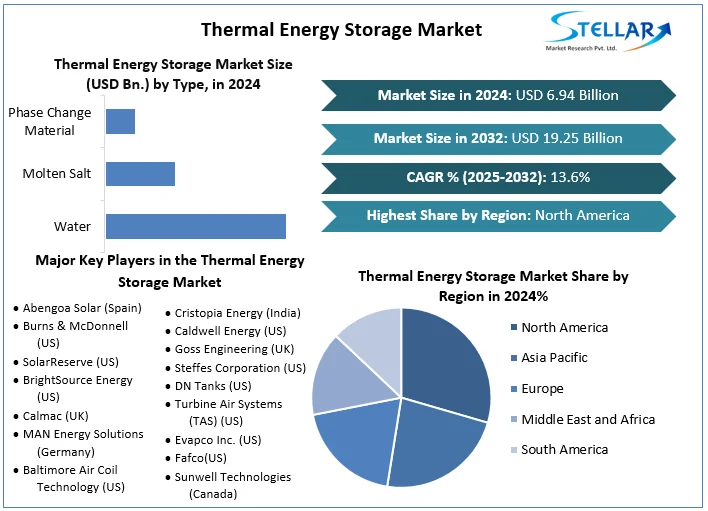
    The Thermal Energy Storage (TES) market refers to technologies that store thermal energy — either heat or cold — for later use in power generation, industrial processes, building heating/cooling, and renewable energy integration. TES systems enable energy captured during low‑demand or peak generation periods to be deployed when needed, improving efficiency, flexibility, and grid reliability. These systems use mediums such as water, molten salt, and phase change materials to store energy through sensible heat, latent heat, or thermochemical processes.

    In 2024, the global thermal energy storage market was valued at approximately USD 6.94 billion. It is projected to grow to around USD 19.25 billion by 2032, expanding at a compound annual growth rate (CAGR) of about 13.6 % through 2032, driven by increasing renewable energy penetration and rising demand for grid‑scale storage solutions.

    Purchase This Research Report at up to 30% Off @ https://www.stellarmr.com/report/req_sample/Thermal-Energy-Storage-Market/356

    Market Growth Drivers & Opportunity
    A key growth driver for the TES market is the integration with renewable energy sources, especially solar thermal and concentrated solar power (CSP). Because solar generation is intermittent, storing excess heat for use during non‑sunlight hours enhances energy reliability and enables continuous power generation from renewable energy. TES systems are essential in CSP plants to prolong generation beyond daylight hours.

    Decarbonization and energy transition goals globally are pushing utilities, governments, and industries to adopt storage solutions that reduce dependence on fossil fuels and balance supply‑demand variability in grids with high shares of wind and solar. TES helps to lower carbon emissions by shifting energy supply from peak fossil fuel generation to stored renewable heat or cold.

    Opportunities also arise from the growing district heating and cooling applications, where thermal storage decouples generation from demand, enabling seasonal and peak load management to reduce overall energy consumption in buildings and industry.

    What Lies Ahead: Emerging Trends Shaping the Future
    Several trends are poised to shape TES market growth in the coming years:

    • Advancement in materials and technology — Thermochemical storage and enhanced phase change materials (PCMs) are gaining interest for their high energy density and long‑term stability, offering efficiency improvements over traditional methods.

    • Grid‑scale integration with renewables — As energy systems expand solar and wind capacity, TES solutions will be increasingly deployed alongside digital grid platforms and smart energy management systems to balance intermittent outputs.

    • Cold storage and HVAC innovation — Ice and chilled water storage systems are being adopted for sustainable cooling solutions in large buildings and data centers, which helps flatten peak electricity demand and improve efficiency.

    • Policy and incentive support — Government incentives and regulatory frameworks aimed at decarbonization and energy efficiency are expected to accelerate TES adoption in utility and industrial applications.

    Purchase This Research Report at up to 30% Off @ https://www.stellarmr.com/report/req_sample/Thermal-Energy-Storage-Market/356

    Segmentation Analysis from the URL
    According to the industry report, the thermal energy storage market is segmented across type, technology, application, and end‑user.

    By Type:
    • Water — Common in sensible heat storage due to low cost and simplicity.
    • Molten Salt — Widely used in CSP and high‑temperature industrial applications.
    • Phase Change Material — Stores and releases energy at specific phase transition temperatures to enhance efficiency.

    By Technology:
    • Sensible Heat Storage — Dominates due to maturity and cost‑effectiveness for large thermal loads.
    • Latent Heat Storage — Efficient for moderate temperature applications.
    • Thermochemical Storage — Emerging for high‑density, long‑duration storage.


    About us

    Phase 3,Navale IT Zone, S.No. 51/2A/2,

    Office No. 202, 2nd floor,

    Near, Navale Brg,Narhe,

    Pune, Maharashtra 411041

    sales@stellarmr.com
    Thermal Energy Storage Market Growth: Driving the Future of Renewable Integration Thermal Energy Storage Market: Growth Dynamics, Key Trends & Future Outlook Market Estimation & Definition The Thermal Energy Storage (TES) market refers to technologies that store thermal energy — either heat or cold — for later use in power generation, industrial processes, building heating/cooling, and renewable energy integration. TES systems enable energy captured during low‑demand or peak generation periods to be deployed when needed, improving efficiency, flexibility, and grid reliability. These systems use mediums such as water, molten salt, and phase change materials to store energy through sensible heat, latent heat, or thermochemical processes. In 2024, the global thermal energy storage market was valued at approximately USD 6.94 billion. It is projected to grow to around USD 19.25 billion by 2032, expanding at a compound annual growth rate (CAGR) of about 13.6 % through 2032, driven by increasing renewable energy penetration and rising demand for grid‑scale storage solutions. Purchase This Research Report at up to 30% Off @ https://www.stellarmr.com/report/req_sample/Thermal-Energy-Storage-Market/356 Market Growth Drivers & Opportunity A key growth driver for the TES market is the integration with renewable energy sources, especially solar thermal and concentrated solar power (CSP). Because solar generation is intermittent, storing excess heat for use during non‑sunlight hours enhances energy reliability and enables continuous power generation from renewable energy. TES systems are essential in CSP plants to prolong generation beyond daylight hours. Decarbonization and energy transition goals globally are pushing utilities, governments, and industries to adopt storage solutions that reduce dependence on fossil fuels and balance supply‑demand variability in grids with high shares of wind and solar. TES helps to lower carbon emissions by shifting energy supply from peak fossil fuel generation to stored renewable heat or cold. Opportunities also arise from the growing district heating and cooling applications, where thermal storage decouples generation from demand, enabling seasonal and peak load management to reduce overall energy consumption in buildings and industry. What Lies Ahead: Emerging Trends Shaping the Future Several trends are poised to shape TES market growth in the coming years: • Advancement in materials and technology — Thermochemical storage and enhanced phase change materials (PCMs) are gaining interest for their high energy density and long‑term stability, offering efficiency improvements over traditional methods. • Grid‑scale integration with renewables — As energy systems expand solar and wind capacity, TES solutions will be increasingly deployed alongside digital grid platforms and smart energy management systems to balance intermittent outputs. • Cold storage and HVAC innovation — Ice and chilled water storage systems are being adopted for sustainable cooling solutions in large buildings and data centers, which helps flatten peak electricity demand and improve efficiency. • Policy and incentive support — Government incentives and regulatory frameworks aimed at decarbonization and energy efficiency are expected to accelerate TES adoption in utility and industrial applications. Purchase This Research Report at up to 30% Off @ https://www.stellarmr.com/report/req_sample/Thermal-Energy-Storage-Market/356 Segmentation Analysis from the URL According to the industry report, the thermal energy storage market is segmented across type, technology, application, and end‑user. By Type: • Water — Common in sensible heat storage due to low cost and simplicity. • Molten Salt — Widely used in CSP and high‑temperature industrial applications. • Phase Change Material — Stores and releases energy at specific phase transition temperatures to enhance efficiency. By Technology: • Sensible Heat Storage — Dominates due to maturity and cost‑effectiveness for large thermal loads. • Latent Heat Storage — Efficient for moderate temperature applications. • Thermochemical Storage — Emerging for high‑density, long‑duration storage. About us Phase 3,Navale IT Zone, S.No. 51/2A/2, Office No. 202, 2nd floor, Near, Navale Brg,Narhe, Pune, Maharashtra 411041 sales@stellarmr.com
    0 Yorumlar 0 hisse senetleri 188 Views 0 önizleme
Arama Sonuçları